What are bullet point lists?
When lists are presented with one list item per line, following an indented marker or symbol. they are commonly referred to as ‘bullet points’ or ‘bulleted lists’. Bullet point lists are widely used in science report writing but are rarely used in peer-reviewed journal articles (primarily due to save space).
What is the purpose of bullet points lists?
Bullet point lists are generally used for unnumbered and unordered lists and allow information to stand out separately from paragraphs and other surrounding text. Well-designed bullet points help attract the reader's attention when skimming a document and help them to quickly absorb multiple subtopics.
Making sure that bullet points are structured correctly also helps writers to clarify their thinking. Bullet point lists avoid the need to force a sentence or paragraph to contain lengthy and unwieldy lists. They allow the writer to be more succinct as the repetition needed to link connected sentences within a paragraph can be removed. They can also help to reduce the word count if the list is composed of simple phrases or sentence fragments rather than complete sentences.
The problems with the use of bullet point lists
Many writers are unsure how to structure bullet point lists and use them incorrectly. Some writers use paragraphs when they could have used bullet points and some overuse bullet points instead of writing paragraphs. Some writers haphazardly throw all types of information into bullet points, making them difficult to read. Therefore, guidelines are necessary.

When and how should bullet point lists be used?
There are different ways to structure bullet points. However, ensuring consistency and clarity of meaning is crucial. Two common questions I’m asked are, “Should bullet points be capitalised?’ and “Should bullet points be followed with commas or semi-colons?” My answer to both is, that it depends on what you are writing and how your structure your introductory elements and list items. An introductory element is the use of a phrase, sentence fragment or complete sentence to introduce the bullet point list.
1. Bullet point lists are introduced with a phrase, a sentence fragment or a complete sentence (introductory element).
The introductory element is usually followed by a colon (See Example 1).
Example 1
The following is a brief overview of:
- my understanding about the broad types of software tools on offer.
- how different pricing models influence my choice of tools.
- the current software tools I regularly use for writing, teaching and managing my training consultancy.
- what to keep in mind when searching for good software tools.
(from ‘FAQ: What software tools do I use for writing and teaching?’)

2. Each list member must logically complete the meaning conveyed in the introductory element.
As Example 1 is introduced with a sentence fragment (‘The following is a brief overview of:’) each list item must form a grammatically-correct complete sentence when combined with it. For example, the second list item would be read as: “The following is a brief overview of how different pricing models influence my choice of tools.” This is why the first word of each list item is not capitalised and why full stops are used at the end of each list item.
It is very common for writers to avoid this important guideline and not check to see if each list item logically follows on from the introductory element. An incorrect way to represent the information in Example 1 would be as follows:
Hypothetical (incorrect) Example 2
The following is a brief overview of:
- my understanding about the broad types of software tools on offer.
- how different pricing models influence my choice of tools.
- Includes a current list of software tools I regularly use for writing, teaching and managing my training consultancy.
- Also some tips to keep in mind when searching for the good software tools.
The last two list items, although still relating to the topic, do not follow on from the introductory element. For example, the 3rd list item would read, “The following is a brief overview of Include a current list of software tools I regularly use for writing, teaching and managing my training consultancy.” This does not make sense.
3. If an introductory element stands alone as a heading, it doesn’t need any punctuation (see Example 3 below).
Example 3
Remember
- Plans are not meant to be perfect but act as a guide to your thinking and a framework to further develop the project you are working on.
- Keep all versions of your plans for future reference or to use as templates for future projects.
- Ask colleagues for feedback on your plans as well as your document drafts.
(from ‘The essentials of science writing: plan before you write’ )
4. If the bullet points are composed of complete sentences, they should be each be treated as a normal sentence with capitalisation and terminal punctuation (e.g. full stop, question mark) (see Example 3 above).

5. Consistency is crucial:
- Use the same symbol or marker for your bullet points throughout your document.
- Although you may have different types (structures) of bullet point lists within the same document, all list items within a bullet point list should be the same format: all phrases, all sentence fragments or all complete sentences.
This is another reason why Example 3 is incorrect as the 3rd point is a complete sentence, while the 4th point is a sentence fragment and both are dissimilar in structure to the first two points.
6. Bullet point lists items that are phrases or sentence fragments need no punctuation (see Example 4 below).
Example 4
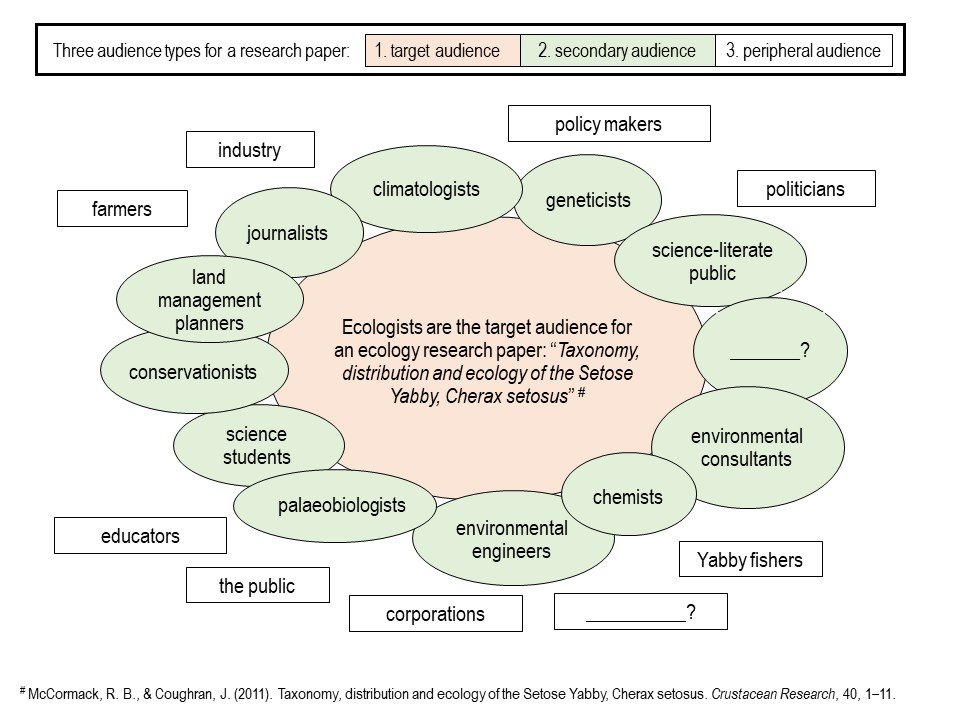
Common writing problems often reflect that a writer has not thoroughly considered who their audience is, or what they need. This can cause the following problems:
- providing too much (or not enough) detail or background information
- providing too much detail on unrelated sub-topics or on a well-known topic
- using the wrong language or unfamiliar terminology
- assuming the audience’s level of interest in, or understanding of, the topic
(from How to identify your target audience,)
7. Ensure that your list items are distinct from each other (compare examples 5 & 6).
Example 5
An example of distinct list items:
I agreed to the following decisions:
- the start date of the project.
- that the consultation committee have a maximum of five registered members.
- the due date of the first stage of the report.
Example 6
An example of indistinct list items:
The following is a brief overview of:
- my understanding about the broad types of software tools on offer.
- how different pricing models influence my choice of tools.
- how different pricing models influence the way I research software tools.
In this example, the 3rd list item is closely related to the 2nd list item, so I would either combine them all leave point 3 out.
8. The list items can be presented in any order. If they must be presented in a certain order, they should be numbered and considered a ‘numbered list’ and not a bullet point list (See example 7).
Example 7
Example of a numbered list
Steps to complete your enrolment:
- Read the terms and conditions.
- Download and complete the application form
- Email the application form to emailus@address.com
- Follow instructions in enrolment notification email.

9. Use commas or semi-colons at the end of each list item if you are presenting a list as though it was part of an entire sentence (see Examples 8 and 9).
Hypothetical Example 8 (with commas)
The site contained the following species:
- Eucalyptus saligna,
- Eucalyptus siderophloia,
- Eucalyptus oreades and
- Eucalyptus regens.
As a complete sentence this would be written as “The site contained the following species: Eucalyptus saligna, Eucalyptus siderophloia, Eucalyptus oreades and Eucalyptus regens.”
This type of bullet point list could also make a complicated list easier to read than if it was written in a sentence (see Example 8).
Hypothetical Example 9 (with semi-colons)
The site contained the following species:
- Acacia daviesioides (over 3 dozen seedlings);
- Acacia glaucoptera (3 shrubs);
- Acacia incurve (over 1000 small to medium shrubs);
- Eucalyptus saligna (over 200 seedlings);
- Eucalyptus siderophloia (one large tree and 3 saplings);
- Eucalyptus oreades (six saplings) and
- Eucalyptus regens (over 300 trees).
As a complete sentence this example would be written as “The site contained the following species: Acacia daviesioides (over 3 dozen seedlings); Acacia glaucoptera (3 shrubs); Acacia incurve (over 1000 small to medium shrubs); Eucalyptus saligna (over 200 seedlings); Eucalyptus siderophloia (one large tree and 3 saplings); Eucalyptus oreades (six saplings) and Eucalyptus regens (over 300 trees).
If you find you are writing these types of sentences or bullet point lists, depending on the type of document you are writing, it might be better to use tables instead.
© Dr Marina Hurley 2021 www.writingclearscience.com.au
Any suggestions or comments please email admin@writingclearscience.com.au
Find out more about our online science writing course...


SUBSCRIBE to the Writing Clear Science Newsletter
to keep informed about our latest blogs, webinars and writing courses.
FURTHER READING
- Should we use active or passive voice?
- 10 writing tips for the struggling ESL science writer
- Co-authors should define their roles and responsibilities before they start writing
- How to write when you don’t feel like it
- When to cite and when not to
- Back to basics: science knowledge is gained while information is produced
- How to build and maintain confidence as a writer
- If science was perfect, it wouldn’t be science
- The essentials of science writing: What is science writing?
- 8 steps to writing your first draft
- Two ways to be an inefficient writer
- Work-procrastination: important stuff that keeps us from writing