Author Archives: Marina Hurley

How to identify your target audience


When we write, we write about something (the topic) in a certain format (the document type) for a reader or group of readers (the audience). Deciding what we are writing about and what type of document to prepare is usually straightforward for most writers. However, deciding who we are writing for is not always thoroughly considered. To a large degree, the audience of a document is determined by the type of document and the subject matter but unless researchers and other science writers have a background in marketing, the concept of identifying and catering to a target audience might not be a high priority.

DOWNLOAD THE INFOGRAPHIC '6 ways to identify and cater to your target audience'

What is your focus?

A document is not simply a receptacle for words, it is a tool of communication that should perform a service for readers. Thinking about who will read our document or what they might want from our document, is something that writers might avoid if they are author-focused or project-focused. Author-focused writers have discoveries, data, knowledge and information that they need to share and primarily concentrate on getting their document published. Project-focused writers key motivation is to satisfy project, organisation, company or client objectives. Audience-focused writers design their document according to the needs of the target audience, while still satisfying their own needs as an author and addressing project and client objectives.
Decide exactly what you want to do for your audience

Unless catering to a target audience is a central objective, your document may lack some of the fundamentals of good document design. Spending the time deciding exactly what you want to do for your audience, rather than simply delivering information, will help you fine-tune the content and the design of your document.

Problems caused by not understanding your target audience

Common writing problems often reflect that a writer has not thoroughly considered who their audience is or what they need. This can cause the following problems:

- providing too much (or not enough) detail or background information

- providing too much detail on unrelated sub-topics or on a well-known topic

- using the wrong language or unfamiliar terminology

- assuming the audience’s level of interest in, or understanding of, the topic

One common mistake in science and academic writing is assuming your audience will know your topic nearly as well as you do. The problem with this assumption is that crucial background information and explanation of fundamental concepts may be omitted. Authors of research papers will often make this assumption deliberately if they are writing about a specialised topic. Yet even in these cases, it is not a good habit to omit important background information and project details that are necessary for the reader to understand the context of the research.

Get feedback

It is easy to fall into the trap of thinking that writing is simply delivering information if you are a solo writer, if you are inexperienced or if you don’t get regular feedback on your writing. If you do get regular feedback, it might not be enough if you only get feedback from people who know your topic well as you do; your colleagues or supervisors may ensure you write a scientifically-accurate document but anyone overly-familiar with your topic may not realise that what you’ve written is not clearly written or easy to read.

There are three different types of audiences to consider

An audience is a collective group of readers and for most purposes we need to think about our readers as a group and generalise about what qualities they have. I define three types of audience for most documents: the target audience, the secondary audience and the tertiary audience. For an example of this definition, refer to the diagram below that outlines the hypothetical audiences for an ecological research paper.
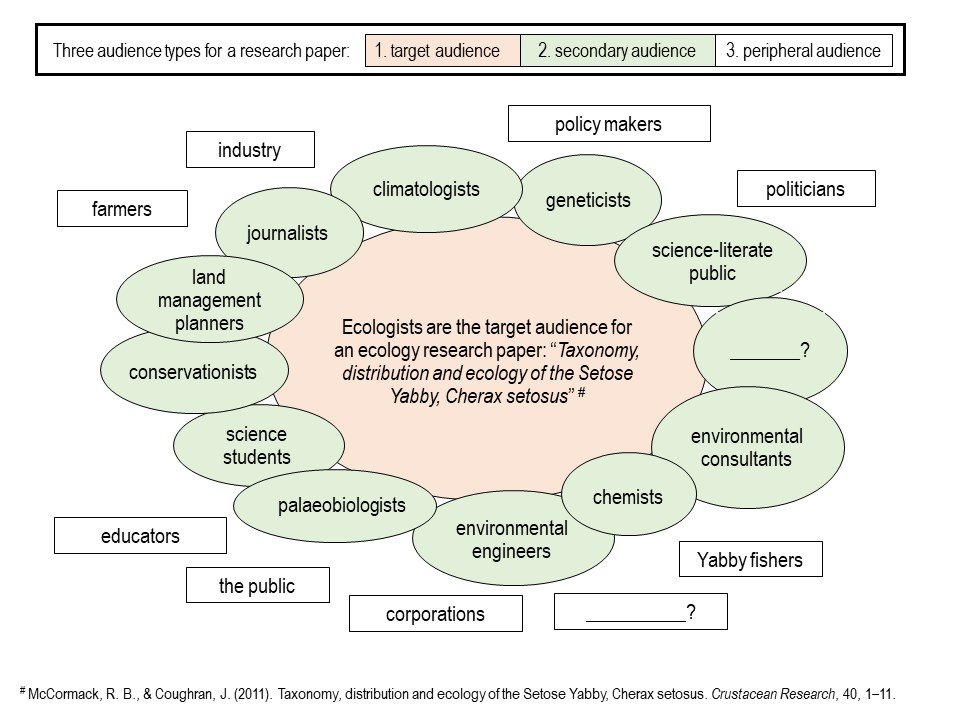
Your target audience is your intended audience. They are the group of readers that you want to read your document or you expect will read your document. These are the people you are designing your document for. Your target audience should understand everything you write. Some examples are research scientists writing peer-reviewed papers for their peers, students writing assignments for their lecturers or consultants writing reports for clients.

Your secondary audience are those people who still want, or need, to read your document but may have different education backgrounds or work within a different discipline to your target audience. For example, the secondary audience of an ecological research paper might be scientists from other disciplines, or other people interested in your topic or your project outcomes; for example, land managers, farmers, conservationists, journalists, science educators or students. Your secondary audience may not be thoroughly familiar with your topic but still has a strong or vested interest in your projects’ outcomes. However, it is not possible to cater to both your target audience and your secondary audience with the same document. You cannot cater to the secondary audience as you would need to provide too much detail or instruction, making it tiring for the target audience to read, or worse make the target audience feel the document is not designed for them.

You cannot explain everything for your secondary audience but you can help them navigate your document by defining your key terms and ensuring your main aim and findings are abundantly clear.

Your tertiary audience are people who will directly or indirectly benefit or be affected by your work in some way but will not read your document themselves; they will learn about your work either through the secondary or target audience of your document. Because your tertiary audience won’t be reading your document, it is crucial for you to ensure your key messages are abundantly clear so they are not mis-interpreted or mis-represented.

Key ways to identify and cater for your target audience

  • Think about who your readers are and whether they fit into either of the three audience categories, then focus on how to cater for the target audience. Some factors to consider:
  • Who will want or need to read your document? What reasons do they have for reading your document?
  • Who will be interested in your topic and key findings? Why will they be interested in reading your document? If they are not already interested, how do you attract them?
  • What is their occupation, expertise, background or level of education?
  • Will they be able to understand all parts of your document? If not, include sufficient detail and explanation to ensure that they do or assign them to your secondary audience.
  • What people need to read your document
  • What task(s) will your document perform for them?
  • How they will find out about your document?
  • How will they access your document?

           DOWNLOAD THE INFOGRAPHIC: 6 ways to identify and cater for your target audience

Once you have clearly mapped out who you are writing to and how you will cater to them. If appropriate, ask someone from your target audience to give you feedback on a late draft of your document. You might find there are some important aspects you still need to consider.

Remember:

  • Do not assume your readers know everything you do.
  • Understand there are different types of audiences who may read your document.
  • Always define your key terms and explain your key concepts.
  • If appropriate, ask someone from your target audience for feedback on a late draft of you rdocument.


© Dr Marina Hurley 2020 www.writingclearscience.com.au

Any suggestions or comments please email info@writingclearscience.com.au 

Find out more about our new online course...


SUBSCRIBE to the Writing Clear Science Newsletter

to keep informed about our latest blogs, webinars and writing courses.

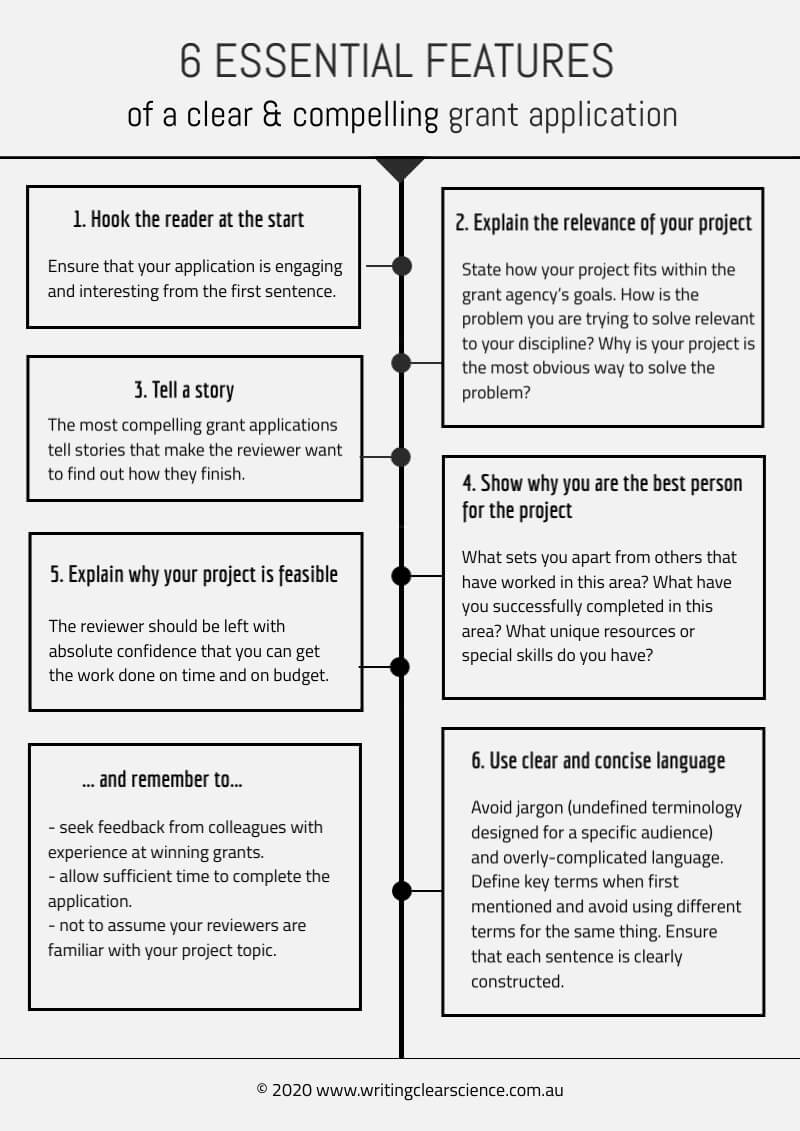
6 essential features of a clear and compelling grant application

Grant applications are usually competitive with multiple applicants applying for the same funding source. A limited pool of money will be available and grant reviewers have to decide which projects are most relevant, follow the required guidelines and likely to produce a successful outcome. You can gain an edge over the competition by ensuring that your grant application is clear, concise and compelling.

DOWNLOAD THE INFOGRAPHIC 'How to write a compelling grant application'

Step 1: Hook the reader from the beginning

In the first stages of reviewing grant applications, there is often a triage, ranking process where some applications are immediately removed from further consideration. Ensuring that your application is engaging and interesting from the start may encourage the reviewer to read on and seriously consider the application.

Creating a catchy and concise title that engages the reader is an important first step. Titles should be short, free of jargon and abbreviations and understandable to the lay person.

If the application guidelines allow, first present a brief overview that neatly encapsulates the entire application. Include a clear summary of the background to your topic, a statement of the project problem and why it is important, followed by a brief statement of why your project is the most obvious way to solve the problem. Clear, simple diagrams on the first page that visually describe the problem can be helpful to the reader.

Step 2: Explain the relevance of your project

Grant agencies usually clearly outline their scope; this is a description of the type of grants and areas of research they will fund. You need to state how your project fits within the agency’s goals at the beginning of the application.

Once you have defined the problem that your project will solve, the next step is to convince the reader that the problem is important and urgent. How common is it? How many people does it affect? What could happen if this problem isn’t solved soon? What does this problem cost the government, the tax payer, the environment and the community? Can the costs of this unaddressed problem be given an estimated dollar figure? Use statistics to back up your claims and cite government documents or published reports or literature or wherever possible.

Step 3: Tell a story

The most compelling grant applications tell stories that make the reviewer want to find out how they finish (and they will want to give you money to see how it ends). Ensure that the reader has all the information presented to them in a logical order, so that they can easily follow the story. Explain each concept before moving onto the next and make sure there are no gaps that will leave the reader confused. Don’t assume that your reader is familiar with the nuances of your project.

Structure your story by first outlining the big picture: begin with an introduction to the broad topic area that over-arches your project. Then narrow your focus to discuss the problem that your project will address. Simply describing a problem and stating that ‘it is important’ is not sufficient. Provide the reader with sufficient background information so they can easily understand why this issue is so important. Never assume your grant reviewer has in-depth knowledge of your topic. Explain all aspects of the problem and then discuss what is not known, so that the reader has an understanding of what will be needed to solve it.

Gradually weave your research intentions into the story, to show how they fit in. What prior knowledge or relevant expertise do you have? Explain all aspects of the problem and your role in the solution, so the reader can easily see what your project will do and how you aim to solve the problem.

Step 4: Show why you are the best person for the project

Convince the reviewer that you are the best person or team to execute a successful project. What sets you apart from others that have worked in this area? What have you successfully completed in this area? What unique resources or special skills do you have?

Give examples of your previous work or publications where possible. If the project involves developing new skills or techniques, the grant application should explain how you have previously been successful in developing other skills or techniques.


Step 5: Demonstrate that your project is feasible

The reviewer should be left with absolute confidence that you can get the work done on time and on budget. Phrases such as “…we have already established…”, “…now that we have found x, we will investigate y” convey momentum and establish feasibility. The grant should drive home the message that the only thing stopping you from completing the project is lack of money.

At the end of the story, tell the reader what will happen next if your project is funded. State the expected outcomes of your project. However, if listing additional benefits of the project, ensure that they don’t cloud the original aim. What you are likely to achieve and how this project will solve the problem should be abundantly clear.

6. Use clear and concise language

Clear and concise language is more engaging and compelling than writing that is dry and long-winded. Too many abbreviations can make the text difficult to read, so try to find a balance between readability and any word limits. Defining abbreviations at the beginning of the document and using bold text makes it easier for the reader to revisit the abbreviation if needed.

Avoid jargon (undefined terminology designed for a specific audience) and overly-complicated language. Define key terms when first mentioned and avoid using different terms for the same thing. Ensure that each sentence is clearly constructed. A good rule of thumb is to ask a colleague or friend to read the application and highlight any sentences that they had to read more than twice.

Thoroughly re-read and revise the application, gradually simplifying the language as you rewrite and edit, without comprising the integrity of your story. Ask an independent person to read the near-final draft to look for spelling or grammatical errors that could interfere with clarity and quality.

… and remember…

- Seek feedback from colleagues with experience at winning grants.

- Allow sufficient time to complete the application.

- Do not assume your reviewers are familiar with your project topic or its importance.

© Liza O’Donnell & Marina Hurley 2020

Any suggestions or comments please email info@writingclearscience.com.au 

Find out more about our new online course...

SUBSCRIBE to the Writing Clear Science Newsletter

to keep informed about our latest blogs, webinars and writing courses.

8 steps to writing your first draft

Many writers find it hard to start writing, and once they do start, after writing a few sentences, they stop and immediately rewrite these sentences until they are perfect. This is a type of procrastination but because it involves writing, it's a hard habit to recognise and then break. Following these 8 steps will help you complete a content-rich imperfect first draft and avoid the trap of getting side-tracked by perfectionism. 


1. Outline your core topic


If you are writing a paper or report, start by outlining the key problems you seek to solve with your project. Briefly outline how they will be (or were) solved, then list the main findings. Develop a broad framework that you can modify and add further detail in later drafts. Write a summary of the what, who, how, where, when, and why?

Don’t try and write perfectly: stick to just writing notes, headings and bullet points that help you understand what direction you are going with your writing. 

2. Identify your audience

What you write and how much detail you provide depends upon who you are writing to, so clearly identify your target audience.
  • What is their background? 
  • Why are they reading your document?
  • What do they already know?
  • What do they need to know?
  • Do you have more than one target audience?
3. Plan with pre-writing

Pre-writing is the thinking, note-taking, outlining, summarising, mind-mapping, brainstorming and question-asking needed to plan and develop your core topic. Pre-writing is where you focus on the big picture while writing your first draft and can include hand-writing and drawing diagrams on a whiteboard or large piece of paper.

Try recording yourself talking about your project or use voice-recognition software to capture additional thoughts and ideas.
4. Make a mess and clean it up in later

The first draft should be messy, rough and amenable to change, allowing you to remould your structure with successive drafts. Write bullet points, sentence fragments, and temporary paragraph headings. Avoid trying to write perfect sentences and paragraphs (polishing). Don’t worry about being repetitive or boring. Avoid making your writing eloquent, stylistic or succinct in the first draft: you can revise and improve your writing as your rework later drafts.

5. Avoid adding minute details

Adding minute details to a specific sub-topic in a first draft can be a form of procrastination from writing about your key points. Aim to produce a first draft that reflects your main ideas without explaining them in minute detail. There is no point adding too much detail in the first draft as you may change your mind about what you want to say. Allowing yourself to change your mind about what you write is another important reason why you should avoid writing perfect sentences in your early drafts.

6. Start writing without engaging your inner critic


Don’t worry if your first draft doesn’t make complete sense. Don’t worry about the reader in a first draft. Don't worry if you're not completely sure about what you want to say or what your final conclusions will be. Give yourself time to develop and improve your thinking as you work through successive drafts. By not writing perfectly in your first draft you are allowing yourself to easily to chop up, delete or dramatically change what you have written. 

7. Don’t stop to do more research

While writing, don’t stop if you are unsure about a particular fact or if you realise your need to look something up. Instead try writing reminder notes to yourself directly in your draft in hard brackets and make time to follow this up later. For example, [I remember that there was a recent report that looked into topic X - look this up] or [ask Luke about those review papers he mentioned during his talk]. Try to do your research before and after each draft. When you allocate time for writing, just write. When you have finished your first draft you can review what you have written and identify topics that need further research.

8. Seek appropriate feedback


When you finish your imperfect draft, seek feedback that is appropriate for what you aimed to achieve. Seek feedback on your key ideas and summary points that outline your core topic. If you follow the protocol of not writing perfect first drafts, ask your colleagues to ignore punctuation, grammar, sentence structure and any lack of details or thorough explanations that can be tackled in later drafts.

and remember...

  • If you give your draft to more than one person for feedback, give the same version to each person and get them to give their feedback separately. Not only is it confusing to read multiple comments and editing on the one document when there is more than one reviewer, some reviewers' opinions may be unduly influenced by someone else's comments.
  • Before you make changes to your first draft, print it out, take it to a cafe and edit it with a pen or pencil. Editing a paper copy of your document can give you a fresh view of what you have written and also break the cycle of making continuous small changes when writing or editing  on screen. It's also easier to view a document as a whole when printed out.
  • Keep both digital and printed copies of each draft so you can quickly retrieve writing that has been previously culled.


© Dr Marina Hurley 2020 www.writingclearscience.com.au

Any suggestions or comments please email info@writingclearscience.com.au 

Find out more about our new online course...


SUBSCRIBE to the Writing Clear Science Newsletter

to keep informed about our latest blogs, webinars and writing courses.